
No School-No Homeschool. Just learning: Our Journey into Unschooling
“Why don’t you send your kids to school?”
It’s the question I’m asked the most.
And honestly, there’s no one-line answer. But there’s always a story.
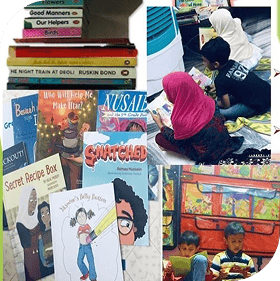
Reading was never formally taught in our home. Apart from Quran reading, there was no structured approach. No worksheets. No phonics. No drills. But the books were always there.
A few weeks ago, I sat with my son after Fajr. The house was quiet, and the sky still slightly blue. While I dozed off, he picked up a book,a 200-page book and read it aloud to himself from 6 AM to 9 AM.
No one asked him to.
No timer ticking.
No reading comprehension test.
Just quiet, undisturbed curiosity and the freedom to explore it.
When we woke up, he was proud of himself and said, “Now, I don’t need to ask… I can read on my own.”
That morning, I paused and thought: this is why we’re here. This is why we chose a different path.
I didn’t come to unschooling overnight. I have worked in schools. I know the system from the inside.
I know the beautiful intentions many schools hold, and I also know the quiet wounds they leave behind in children and parents alike.
We didn’t choose unschooling because we think schools are terrible. We chose it because we deeply believe there is another way. A way where a child’s spirit doesn’t have to shrink to fit a timetable. Where the nervous system is safe. Where learning is led by love, not fear or performance.
I have seen children light up when they feel seen, and shut down when their bodies are tired but the timetable says it’s “Math time.” I have heard parents complain and worry because their child no longer loves to learn.
In our home, learning doesn’t look like “school at home.” It looks like…
…a child saying mid-class, “I’m tired,” and being allowed to rest without guilt.
…a six-year-old getting a personal story written with the help of an older cousin for her mom because she wants to express herself, where the desire to write comes from a need to express, not because you have to write for homework.
I am constantly surprised by how gracefully and confidently he engages in his classes, chatting with his Egyptian teacher, asking them about their culture, their country, and talking about his own.
That moment stayed with me, the day he told his teacher he didn’t feel like continuing the class. A small part of me was triggered. In school, all our life we were taught to obey, to never talk back, to stay until the bell rang. But here he was, listening to his body and expressing his needs. And the teacher listened. It was a moment of growth for both of us.
Once, when he was not feeling well, he asked the teacher to play a game and they did. Cross and zero. In that session, I saw what learning looks like when it’s child-centered, not curriculum-centered.
Most of all, it looks like freedom. Days paced for connection. A rhythm set not by bells, but by moods, energy, and meaning.
I have learned that children lean into learning when their bodies are regulated, their hearts are safe, and their minds are free. I’ve seen them resist force and respond to respect. And somewhere along the way, I started unlearning too.
We’re not just unschooling our children, We are unschooling ourselves. Letting go of control. Untangling from urgency. Questioning the obsession with productivity. Re-learning what it means to parent without fear.
Right now, I’m in the final stages of becoming a trauma-informed parent coach. But this journey is far from theoretical for me, it’s deeply personal.
I am learning to see behaviour through the lens of safety. To ask, What does this child need right now to feel safe enough to learn? I’m learning that real education begins not with a syllabus, but with trust.
And I am realizing that when a child’s nervous system is honored, their God-given fitrah-that natural curiosity, resilience, and connection to truth has the space to flourish.
This isn’t a manual. It’s just a glimpse into our life, where learning happens every day, but rarely in the ways the world expects.
I don’t share any of this because I think unschooling is for everyone.
Every family’s reality is different. But I do share it for the mother wondering if she is enough.
For the parents looking for another way.
For the curious soul who wants to believe that love and trust can be the foundation of learning.
We are still figuring things out, and maybe we always will be.
But what I know for certain is, this isn’t just about education.
It’s about how we choose to live.
If you are on a similar journey, or even just thinking about one,
I would love to connect. Let’s keep learning together.
I would love to hear your thoughts.
Have you experienced seasons of learning outside the traditional school or homeschool setting?
Share your stories in the comments, your perspective might just inspire someone else’s journey.
5 Comments
-
Noor e Muzammil Mansuri
Beautifully explained in a very easy word’s
-
Iqbal Sattar
Assalam o alaikum
Learning process is very intreting.Maulana Azad , never went to any school.but he learnt at home.He became great collar and writer.But our system believes in Certificates and degrees.If you have a degree after ssc.you are learned.Otherwise no.
System needs to be changed.
-
Shafiullah
Now, this era for Deschooling
-
Aishwarya
The best part is trusting our kid. Absolutely love your thoughts. This is very motivating and encouraging for parents who want to unschool their kids and themselves. I would love to read more of such articles on unschooling from you.


Tasneem Belim
I truly enjoyed reading this newsletter. The ideas and experiences shared resonated deeply with me as a parent who also believes in homeschooling and child-led learning. I appreciate the emphasis on allowing children to learn with joy, curiosity, and freedom, rather than under the strict rules and rigid structures of traditional schooling.
I have recently started exploring these concepts and learning more about conscious parenting. I make an effort to read parenting resources and take insights from wherever I can find them, especially when they help me understand my children better and support their growth.
Your words have inspired me further to trust my children’s natural ability to learn and to create an environment at home where they can thrive at their own pace. Thank you for sharing your journey — it has been both encouraging and motivating.